it’s our pleasure to welcome Lyra Robinson to our subnetAIR program 2026!
As every year, a mixture of local and international artistic positions has been sought out. The selected project proposals and persons are characterised by ambitious objectives and thematic relevance.
The jury’s decision was to give one subnetAIR slot to Lyra Robinson because „Lyra Robinson proposes the exploration of a computational model of Caenorhabditis elegans, a 1mm nematode worm. Following a path of speculative fabulation, the artist investigates different forms of being and knowing. In doing so, the project invites audiences to reconsider the boundaries between empirical understanding and imaginative interpretation, revealing new possibilities for interdisciplinary dialogue. The jury wants to encourage that and approves (1.) the open and creative approach that will produce, amongst other artifacts (like renderings of worm variations), a real-time audiovisual system as an immersive experience, as well as (2.) the necessity to inquire what art can offer that science can not.“
Lyra Robinson on her project:
I propose to develop a new body of work exploring the OpenWorm simulation – an open-source computational model of Caenorhabditis elegans, a 1mm nematode worm with exactly 302 neurons. This microscopic organism has been
fundamental to biological research for over 50 years; every synapse mapped, every cell division documented. It is perhaps the most thoroughly known organism on Earth.
Working with OpenWorm’s neural simulation (c302) and physics engine (Sibernetic), I will create speculative modifications to the worm’s body plan and neural architecture – generating impossible worms, alien morphologies,
tentacled variations that push against biological constraints. As synthetic biologist Drew Endy states: „The current life forms are only the tip of the iceberg of the possible life forms.“ What happens when we give C. elegans the body plan of hypothetical organisms on Jupiter’s ice moons? What does a worm look like when its neural topology is rewired for environments that don’t exist?
This connects to Donna Haraway’s concept of „string figures“ – practices of thinking-with and making-with that create patterns of knowing through collaborative play. The worm becomes a partner in speculative fabulation, a tool for exploring what Haraway calls „sympoiesis“ (making-with) rather than autopoiesis (self-making). C. elegans has been biology’s workhorse for decades – a model organism that has given endlessly to human knowledge. What do we owe it in return? What can art offer that science cannot?
My practice investigates how classification systems, machine learning architectures, and computational models shape what counts as knowable, visible, and real. The OpenWorm project extends these investigations into questions of biological representation, asking: how do we know nonhuman beings? What forms of life remain unthinkable within our current scientific paradigms? The work explores what I call „microbially-rooted speculative fabulation“ – using the smallest scales of life to imagine radically different forms of being and knowing.
Lyra Robinson (b. 2002) is a transmedia artist whose work spans performance, installation, and video. Her practice is concerned with the mechanisms through which bodies are read, understood, and made legible in their interactions with surveillance technologies and data gathering. She explores the possibilities for disrupting established knowledge systems to imagine new forms of embodied agency. Informed by Critical Posthumanism and Cyborg theory, Lyra investigates how corporeality, data, and visuality are entangled in contemporary visual infrastructures and platforms. Her work interrogates the multiplicities of power, sex, and sexuality that are enfolded into emergent human-machine ecologies. She works primarily with ones and zeroes; manipulating experimental machine vision and deep learning processes to analyse the material and textural qualities of generative models built from mass data extraction, seeking to expose which parts of the models don’t work, and what the data doesn’t show. Her primary mode of inquiry is through moving image, using new and unconventional media to position diagnostic practice as a liberating act of play. She has recently exhibited at the Tate Modern and Photographer’s Gallery in London, and internationally at CICA museum in Seoul.
More about her works here.
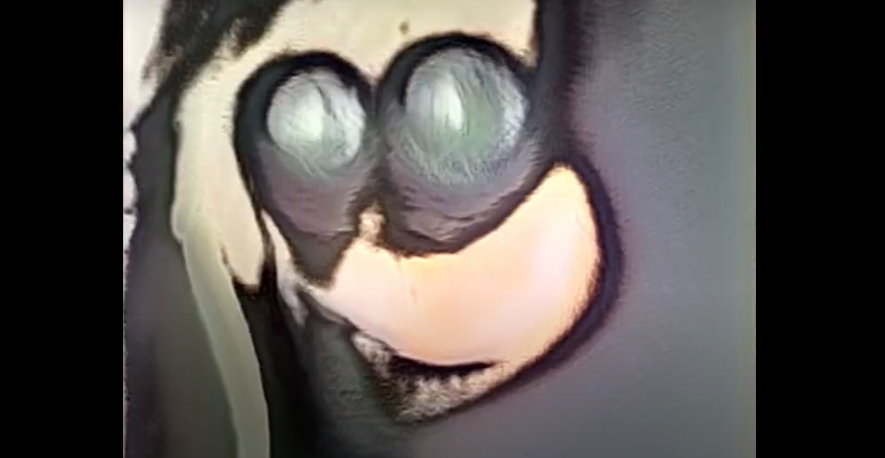
Picture credit: Lyra Robinson: „facesvid1“
subnetAIR27 will be calling this summer and deadlining on October 31st 2026.
subnetAIRs 2019-2024 are presented here
subnetAIR Exhibitions:
2022 Medien.Kunst.Realitäten – Katalog
2018 possible bodies – Katalog
2015 Klanghypothesen – Katalog
subnetAIR 2016 -2022:
# Jana De Troyer – documentation
# Martina Fröschl – documentation
# Scarlett Yang
# Corrie Francis Parks (MediaART Stadt Salzburg) – documentation
# Chun Shao – documentation
# Katsuki Nogami – documentation
# Margarethe Maierhofer-Lischka – documentation
# Nora Jacobs (MediaART Stadt Salzburg) – documentation
# Lukas Gwechenberger – documentation
# Stefan Tiefengraber – documentation
# Stefano Mori – documentation
# Simon Whetham – documentation
# Silvia Rosani and Tom Jacques – documentation
# Vera Sebert – documentation
# Michaela Schwentner – documentation
# Mac Krebernik – documentation
subnetAIR Ausstellung: possible bodies (2018) – Katalog
# Lale Rodgarkia-Dara – documentation
# Simon Faulhaber
# Georg Scherlin – documentation
# Iulia Radu
# Nicolò Cervello
# Robert B. Lisek – documentation
# Kanari Shirao – documentation
# Laura Splan documentation
#Antoni Raijekov – documentation
# Young Suk Lee – documentation
# Danny Bracken
# Lucie Strecker
2015subnetAIR Ausstellung: Klanghypothesen (2015) – Katalog
# Myriam Bleau
# Robert Praxmarer – documentation
# Nikolas Psaroudakis – documentation